
Desert Anterior
Rummaging in the Archives

I spend a considerable amount of time with old documents and archives, both physical and digital. Upon encountering a new one, the feeling is always the same: the initial thrill, an anticipatory build towards an impending revelation. Images congeal in the back of the skull: the perfect document, the ancient xerox copy of this or that capable of unveiling a forgotten or forgotten truth. Achille Mbembe once wrote that the archive is a paradoxical zone: the state cannot exist without the state, but the existence of the archive is simultaneously a threat to the state. The state needs a historical memory through which it constructs and justifies itself, and the archive fulfills this function. But the archive also contains the things that run far beyond what the state wishes to disclose. The excavation of ancient paper1 is precisely the search for the shards of history that the state has screened-out.
The reality of the process is always different from the mental picture. The fantastic, sought-after singular document is in reality dispersed into a network of ten-thousand or more artifacts, fact-fragments like small pieces of paper that float on the air. The scouring of one archive inevitably leads to the multiplication of archives, each containing their own initial sense of promise and eventual feeling of frustration. No one person has the time, nor the resources, to descend into them all.
Over the last decade, there is one particular collection of papers and files that I’ve returned to again and again, always for different purposes, and always resulting in a new discovery. These are the papers of Danny Casolaro, the journalist who was clearly murdered by the state in a Martinsburg, West Virginia hotel room in August, 1991. There’s no need to recount the entire Casolaro saga—I’ve also written about it before here on my blog—other than to say he went further than probably any other in unriddling the state-sanctioned crimes of 1970s and 80s America. We could also comfortably say that what he was chasing—and the circumstances around his death—are the subjects of ongoing cover-ups.
We don’t have all of his papers. A briefcase of files went missing from the hotel room where he died. What survived was collected by his family and deposited at the Missouri State Historical Society. In 2016, a sizable portion were photographed and uploaded to archive.org.
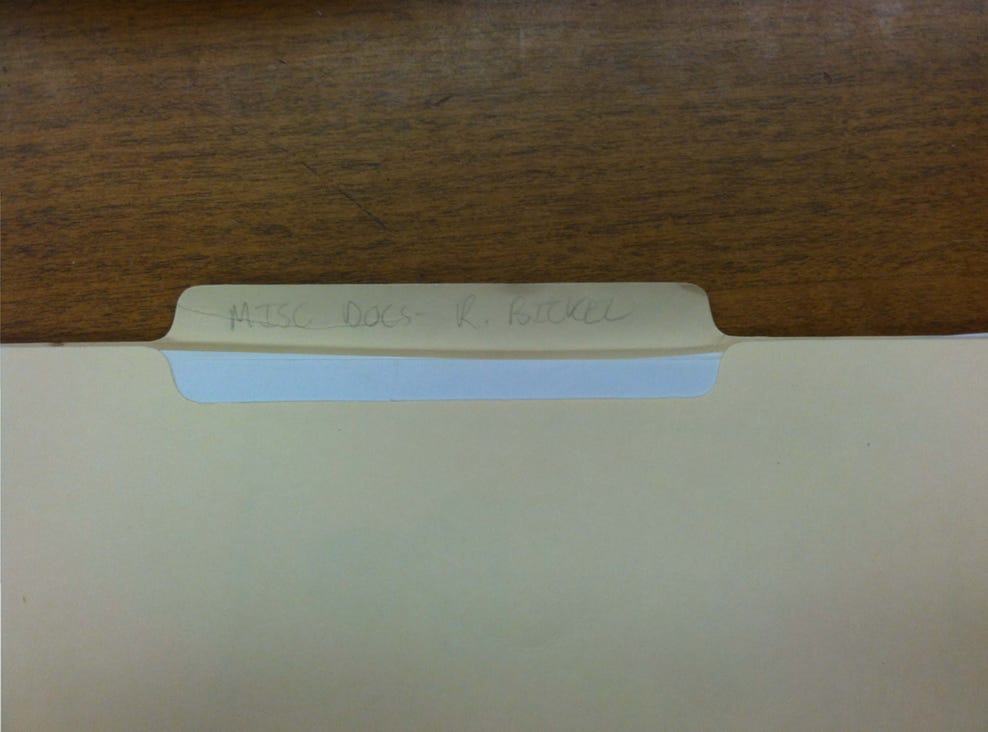
Of the thousands of pages contained in those scans—which, taken together, form a cartography of Actually Existing America—it has been a particular subsection that drives my perpetual return. Scattered across seven or eight folders are the personal files of a man named Robert F. Bickel. A freelance investigator (we’ll learn more about his own story shortly), Bickel built out an impressive network of contacts, chased spies and arms traffickers, and acted as a key node in an information sharing-network around a number of fellow investigators, journalists, conspiracy theorists, and perhaps even conspirators.
It is impossible to determine a central organizing pillar around which we can anchor the Bickel materials. It’s all too dispersed, the data too granular.
One element that does emerge from Bickel’s papers (besides the geopolitical intrigue) is the existence of a particular type of individual. They appear repeatedly, lives turned into ciphers through inexplicable encounters and absurd events. These people are not defined in terms of their class positions. Often they are proletarians, but more frequently they are petty-bourgeois. Others still come from the ranks of the lumpenproletariat. Beyond each of these, they usually float in the ambiguous borderlands of class. At first glance they seem to inhabit more a certain sensibility—one that has made them conducive to operationalization by the most covert dimensions of the state apparatus.
Stephen Pizzo, co-author of one of the great books on the savings and loans crisis of the 1980s, wrote about precisely this type in a 2019 essay. There, Pizzo recalled how he and his colleagues repeatedly found self-declared CIA operatives at seemingly every bank collapse and S&L fraud that they investigated. Why was this happening? A figure from the CIA itself seemed to provide an answer:
We find those kinds of people at places like small county airports and firing ranges… We approach them, show them our IDs and ask them if they’d like to serve their country. The first thing we do is put them with someone else we just picked to spy on for us. Then we give them a job that could get them arrested. When that happens we get them out, and after that we own them.
Bickel’s papers, when placed into alignment with other records from the period, begin to offer us glimpses of this machinery in action.
Link Analysis
Joe Kelso, a strange character from the even stranger city of Denver, Colorado, had acted as a source for Pizzo and his colleagues as they followed the savings and loan trail. A deposition that he gave to Daniel Sheehan, provided when the fallout of Iran-Contra was still hanging thick in the air, also reveals that he matches the description of Pizzo’s unnamed CIA officer to a T.
First came the work history: as the recording tapes ran, he described to Sheehan how he had been employed by a series of companies dedicated to infrastructural work—oil and gas pipeline management, public safety support, and, ultimately, a fire control and extinguisher outfit called Global Extinguisher Systems (EGS). Along the way contact was made with military intelligence figures that are identified in the deposition text only as “SF-1” and “SF-2” (I assume that the ‘SF’ stands for ‘special forces’). Kelos and the SFs traveled around the American West—Colorado, Montana, the Dakotas—honing sharpshooting skills at various remote shooting ranges. The two even began to school Kelso electronic tradecraft: the how-to’s in deploying sophisticated equipment for bugging and wiretapping.
Per Kelso’s story, he crossed paths around this time with a CIA officer named Bill Chandler. EGS also happened to be employing a “former” CIA operative, Paul Unger. That Kelso was working with Unger in the fire extinguisher business while being cultivated by Chandler apparently failed to raise any questions in his mind, nor did he seem to connect either of these figures with the elusive ‘SFs’ that had abruptly entered his life. This all had the trappings, as Kelso later recounted in his deposition, of a big coincidence, hardly worthy of even mere curiosity.
Keep reading with a 7-day free trial
Subscribe to Reciprocal Contradiction 2.0 to keep reading this post and get 7 days of free access to the full post archives.