
America
Stray thoughts and more from the archives

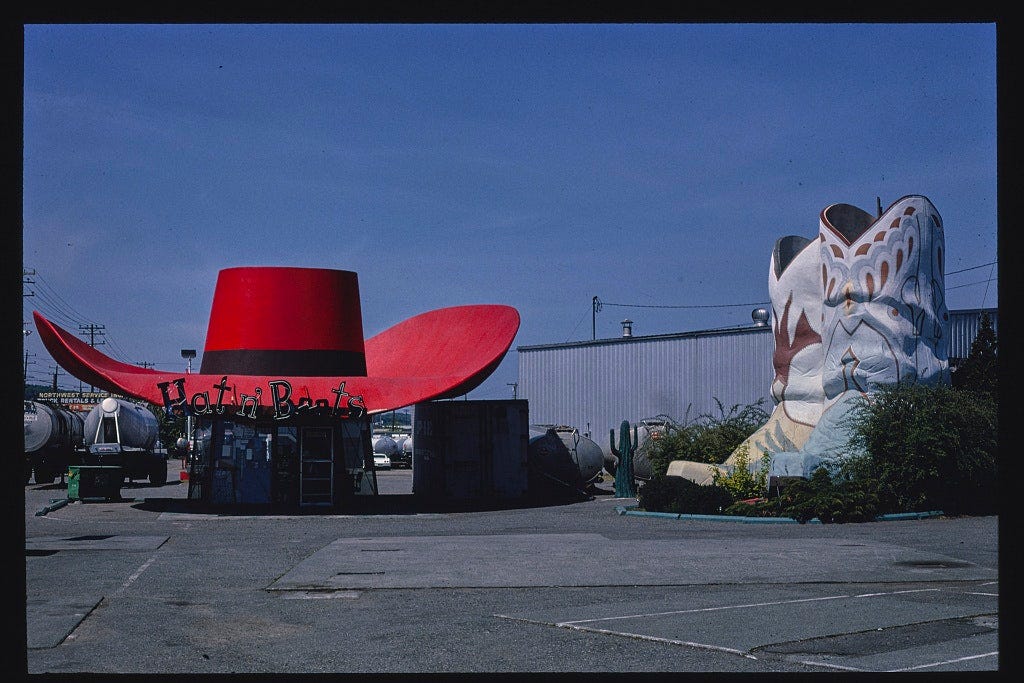
It’s election day, mere hours away from vote tallies that will decide, according to the media cartel’s perpetual and repetitive chorus, the outcome of this country’s most pivotal historical moment. It’s cynicism at its worst: it’s not only are we in a time of true decadence (in the proper sense of the word, not the tepid right-wing appropriation of it to label cultural patterns that upset them), with all historical content utterly emptied from the jagged flow of events. There are also the undeniable empirical facts—too trite to bother with recounting, leave that to the pundits—that both campaigns and the parties behind them have reached a point of absolute exhaustion. All that’s left, behind the most flimsy facade of political engagement and public opinion, are the immovable gears of state-led administration of finance, war, and opinion management churning away.
Trump’s energy clearly collapsed before Elon Musk started hopping around spastically on stage—maybe it was the assassination attempt that did him in, or maybe he was always destined to short-circuit into sad crypto schemes and the like. For Kamala, the boost of Brat Summer was never sustainable and was clearly destined for short-term burnout (as an aside, Charli XCX might need to be investigated for foreign interference in the American political process. The British Empire never ended).
The American system maintains itself on the illusion that it is a rational order. Domestically this manifests in the forms of dynamic balance, a careful equilibrium struck between the different competing interests that come together under the common label of the ‘United States’ and its myriad of populations and cultures. On the world stage American rationality has coalesced into the ‘rules-based international order’, which is designed to simultaneously regulate geopolitical events and the so-called ‘free trade’ system that acts as its substrate.
This is the so-called ‘open society’, which, ironically, is the projection on a global scale of what Paul Edwards described as the ‘closed world’—a mode of discourse and logic of administration that was ultimately a child of the Cold War. Here’s how Edwards describes it:
the language, technologies and practices that together support the visions of centralized control, automated global power at the heart of American Cold War politics. Computers helped create and sustain this discourse in two ways. First, they allowed the practical construction of central real-time military control systems on a gigantic scale. Second, they facilitated the metaphorical understanding of world politics as a sort of system subject to technological management. Closed-world discourse, through metaphors, techniques and fiction as well as equipment and salient experiences, linked the globalist, hegemonic aims of post-World War II American foreign policy with a high-technology military strategy, an ideology of apocalyptic, and a language of integrated systems.
Though Edwards doesn’t touch on it, the carefully-designed mechanisms governing the universal system of techno-militarized rationality that the Cold War order incubated also called forth its profound opposite, a disturbing and apocalyptic irrationality that served as this order’s occult core.
The best example of this can be found in the 44-rung ‘escalation ladder’, developed by Herman Kahn to describe the rise from the subterranean tremors of geopolitical fault lines to the final nuclear showdown between Great Powers. Positioned at the top of the ladder is what is alternatively described as the spasm war or war-spasm. It’s at this point that all the tension, all the dread, anxiety and fear collapses into a joyful and hallucinatory enthusiasm, the planners and technicians overtaken by fevered delirium, hands hitting the launch buttons and letting the missiles soar, arcing towards Moscow, Leningrad, towards New York and DC, approaching the ballistic missile fields buried in the dark soils of the Dakotas and bunkers entombed deep below Colorado’s mountain ranges.
If the term ‘war-spasm’ carries with it strange and faint erotic overtones, this is intentional on the part of those who designed the escalation ladder: this quivering intensity was seen as almost drenched in libido—nuclear war’s universal conflagration becomes a deathly orgy as both summit and culmination of civilizational development.
Everything in the post-Cold War period was founded on the justification of suppressing this final moment, the technocratic end of history as the purgation of the irrational kernel, paving way for enlightened administration: utopian vision of an American-crafted peace, justified upon itself and durable for the remainder of time.
The shaking of the geopolitical fault-lines, the impossibility of restoring sound economic growth and the wars that rumble, distant and on the peripheries for the bulk of Americans but which are very real and catastrophic and relentlessly tragic for those swept along in its fires, have shattered this crystallization, unmasking it for what it really is: the most brutal exploitation of the human masses, something spiraling ever-closer to its final breaking point, a point that is nonetheless ever-deferred. Asymptotic—a global empire forever collapsing into itself, but never capable of finally giving way.
What follows are a few archival blog posts written in July of 2020. How they might relate to this present moment is obscure to me, aside from the fact that I was thinking about the total paradox burning in the heart of America, the complete disjuncture between certain liberatory impulses and the tendency towards total administration.
I’ve had a longstanding and extremely unfashionable interest in the theoretical output of the Telos journal and their notion of ‘artificial negativity’. It goes something like this: Telos wanted to craft a specifically American critical theory, a sort of follow-up in the American context of the Frankfurt School. They suggested the Marcusean “One Dimensional Society” had already been superseded, and that since the 1960s, a new dynamic had been injected into the social field. This was artificial negativity, the deployment of oppositional forces against the social system that nonetheless constituted a commanding logic for the expansion of the system, and which are shaped and molded its very logic.
Maybe it’s time to think about what it means when artificial negativity—or something like it—has likewise been superseded, when the oppositional motor, even if that opposition is ungrounded in the fog of illusion and false consciousness—likewise falls away, little embers fading out like dying stars. What is left?
Post I: American Cartographies (07/14/2020)
I think I’ve written about this before—and if not on the blog, then at least on twitter—but one of the bits in A Thousand Plateaus that has fascinated me for years now is a footnote to the introduction (on the rhizome). It takes place in the context of a short discussion of America, identified as a “special case” where the distinctions dynamic unfolding of arborescence and rhizomatics undergoes a stark mutation. Development ceases to unfold in a linear, straight-forward manner, but becomes an affair of offshoots, splits, underground connections, and strange happenings. Literary logic alters and strives to overcome the European inheritance. Directionality itself transforms: “the search for arborescence and the return to the Old World occur in the East… [America] put its Orient in the West, as if it were precisely in America that the earth came full circles; its West is the edge of the East”.
In the foonote to this section, these insights become the means to identifying a geographical schema (geophilosophy = schizoanalysis) for the unfolding of American literary history. Referring to the literary critic Leslie Fielder and his work The Return of the Vanishing American, Deleuze and Guattari write
This book contains a fine analysis of geographical and its role in American mythology and literature, and of the reversal of directions. In the East, there was a search for a specifically American code and for a recoding with Europe (Henry James, Eliot, Pound, etc.); in the South, there was the overcoding of the slave system, with its ruin and the ruin of the plantations during the Civil War (Faulkner, Caldwell); from the North came capitalist decoding (Dos Passos, Dreiser); the West, however, played the role of the line of flight combining travel, hallucination, madness, the Indians, perceptive and mental experimentation, the shifting of frontiers, the rhizome (Ken Kesey and his “fog machine”, the beat generation, etc.). Every great American author creates a cartography, even in his or her style; in contrast to what is done in Europe, each makes a map that is directly connected to the real social movement crossing America.
Amy Ireland’s textual exegesis on the most mysterious of plateaus in ATP, the ‘Geology of Morals’, highlights how across Deleuze’s work, cardinality and the four points of the compass operate in a complex with the motif of the “revolving door” to illustrate a double articulation of time. On the one hand, it presents the great pre-critical models of temporality, bound to the arcing circles of the celestial bodies that marked the cyclical movement of time from Plato through the Middle Ages. Yet on the other hand, an esoteric meaning of the revolving door emerges. In the GoM plateau, the revolving door appear as the ‘drum-gate’ and ‘particle clock’ through which Professor Challenger slips on his stationary voyage of destratification. His destination is the plane of consistency, the planomenon…
The American cartography in the rhizome footnote appears to adhere to this scheme. On the one hand, there is the fourfold cardinality of north, south, east, and west—but there is also the escape-path moving westerward.
The use of geographical orientation is deployed in another very odd passage found in the “How Do You Make Yourself a Body without Organs?” plateau. Desire, Deleuze and Guattari write, can be ‘betrayed’ in three different ways, which they label “the negative law, the extrinsic rule, and the transcendent ideal”. This “triple curse” is executed by the figure of the priest through something of a banishing rite that is tethered to the cardinal directions. They write:
Facing the north, the priest said, Desire is lack (how could it not lack what it desires?). The priest carried out the first sacrifice, named castration, and all the men and women of the north lined up behind him, crying in cadence, “Lack, lack, it’s the common law”. Then, facing south, the priest linked desire to pleasure. For there are hedonistic, even orgiastic, priests. Desire will be assuaged by pleasure; and not only will the pleasure obtained silence desire for a moment, but the process of obtaining it is already a way of interrupting it, of instantly discharging and unburdening oneself of it. Pleasure as discharge: the priest carries out the second sacrifice, named masturbation. Then, facing east, he exclaimed: jouissance is impossible, but impossible jouissance is inscribed in desire. For that, in its very impossibility, it is the Ideal, the “manque-a-jouir that is life”. The priest carried out the third sacrifice, the phantasy or the thousand and one nights, the one-hundred twenty days, while the men of the east chanted: Yes, we will be your phantasy, your ideal and your impossibility, yours and also our own. The priest did not turn to the west. He knew that in the west lay a plane of consistency, but he thought that the way was blocked by the columns of Hercules, that it led nowhere and uninhabited by people. But that is where desire was lurking, west was the shortest route east, as well to the other directions, rediscovered or deterritorialized.
This is a rich passage, dense with allusions—take the reference to the ‘columns of Hercules’, for instance. While what immediately springs to mind is Plato’s description of the mythical isle-kingdom of Atlantis as existing beyond the columns of Hercules, in this case referring to the Straits of Gibraltar. It’s not far from here to the take-up of the myth in the annals of European hermeticism: Atlantis as both source (the primordial fount of civilization) and future (as in the understanding of the New World in the West as the ‘New Atlantis’), each illuminating a more fundamental sense of profound otherness, a beyond that lurks past the end of any temporal orientation. Seen from this point of virw, the columns of Hercules take on the symbolic significance of the gates towards the unknown.
The more immediate reference that Deleuze and Guattari are likely to be reaching for is the use of the columns of Hercules as a symbol used by Kant in the Critiue of Pure Reason. In the discussion on transcendental logic, Kant described the ‘pillars of Hercules’ inscribed with the words nihil ulterius, ‘nothing beyond’: it is beyond this point that critique is not to venture. The pillars themselves were “erected by nature in order that we pursue reason’s voyages only insofar as as the steadily continuing coasts of experience extend”. The Atlantean promise, following a Renaissance legend of the pillars, is inverted by Kant through this stark warning. If beyond the pillars, in the west, lay the plane of consistency, then Kant has fulfilled the function of priest who turns his back to this direction.
There is a clear correlation between the characteristics of the west in both the rhizome footnote and the BwO plateau passage. Perhaps, then, the other directions also correspond. This is clearly the case with the north: in the rhizome footnote, Deleuze and Guattari identify it most explicitly with capitalist social dynamics. While this might seem oblique in relation to the ‘sacrifice of castration’ that curses desire with lack, it proceeds quite smoothly from the argument staged in Anti-Oedipus. Desire as such doesn’t stem from lack, for lack is manufactured by the social field that desire is embedded within—and it is the social field generated by the capitalist mode of production in particular that induces this dynamic tendency.
The south raises a more difficult set of question. In the rhizome footnote, the south is linked with the overcoding of the slave system (pre-Civil War) and the ‘ruin of the plantation (post-Civil War), while in the BwO plateau, it is identified with the binding together of desire and pleasure, culminating in orgasmic discharge. Yet what has been the popular imaginary that has been so associated with the planatation system but the leisurely pleasureworlds of the landed slave-owning aristocracy? While this imaginary portrait—accompanied by the trappings of grandeur, chivalry and virtue—has fueled the ‘Lost Cause’ mythos, it does have a basis in reality: freed from labor, the aristocrat was indeed free to pursue his pleasures, which extended beyond leisure to culture and politics. That this transformed into a suicidal drive that culminated in violent war shouldn’t surprised readers of Deleuze and Guattari: the logic of pleasure is at one and the same as the fascist drive, understood as the state locked into the momentum of the most extreme sort of death drive, are one and the same (the pleasurable discharge and the black hole of death, which the fascist state is pulled towards, converge on this point as well).
I recently read an absolutely fantastic book by Richard Bensel: Yankee Leviathan: The Origins of Central State Authority in America, 1859-1877. What is novel about Bensel’s historical analysis is his discovery that, contrary to the long-standing notion that the North was the zone where centralized state power reigned supreme, the far-more laissez-faire inclined South actually built a more dominating, more centralized war-time state. It brings to mind Deleuze and Guattari’s own insight that the state becomes suicidal as precisely the point that it becomes taken over by the ‘war machine’, which then propels the whole of the population on the tragic path of total mobilization.
This leaves the question of the East, associated in the rhizome footnote with both the ‘search for an American code’ and a ‘recoding with Europe’, and in the BwO plateau with impossible jouissance and phantasy. While I initially read phantasy as fantasy, Matt/Xenogoth pointed out to me that the proper understanding of phantasy makes the alignment between the two much clearer. Phantasy, in contrast to fantasy, is the “state of mind of an infant child during the early stages of development”, where the boundary between ‘reality’ and the imaignation has not yet been established. In the psychoanalytic work of Melanie Klein, phantasy appears in particular as the place where the infant engages in experimentation with the world—”the baby tests out, primitively ‘thinks’ about, its experiences of inside and outside”. In a similar vein, the East is where American began its own infancy, and the ‘search for the American code’ corresponds to this developmental engagement that results in particular processes of individuation.
When Deleuze and Guattari deal with the notion of phantasy elsewhere in ATP, it is to contrast it with the radical immanence of the BwO. The Capitalism and Schizophrenia project is an engineering manual designed, in Spinozist fashion, for ‘deprogramming’ and destratification—and the BwO is the degree zero of intensity, that which “remains when you take everything away”. What is removed to reach the BwO is identified as none other than phantasy itself, understood as the engine for “signifiances and subjectifications as a whole”. If the distinction between psychoanalysis and schizoanalysis can be boiled down to one point, it is this: psychoanalysis “translates everything into phantasies”. It also marks the point of the failed escape; Deleuze and Guattari cite the example of the drug addict, those individuals who “may be considered precursors or experimenters who tirelessly blaze new paths of life”, but “continually fall back into what they wanted to escape: a segmentarity all the more rigid for being marginal, a territorialization all the more artifical for being based on chemical substances, hallucinatory forms, and phantasy subjectifications”.
This same process—the bid for escape, the collapse back into the prison—is the same pendulum-swing as the ‘search for the American code’ and the ‘recoding with Europe’. It appears, time and time again in Capitalism and Schizophrenia, often accompanying the scattered discussion on America. A Thousand Plateaus, right at its outset:
America is a special case. Of course it is not immune from domination by trees or the search for roots. This is evident even in literature, in the quest for national identity and even for a European ancestry or genealogy (Kerouac going off in search of his ancesters).
…and earlier, in Anti-Oedipus:
Strange Anglo-American literature: from Thomas Hardy, from D.H. Lawrence to Malcolm Lowry, from Henry Miller to Allen Ginsberg and Jack Kerouac, men who know how to leave, to scramble the codes, to cause flows to circulate, to traverse the desert of the body without organs. They overcome a limit, they shatter a wall, the capitalist barrier. And of course they fail to complete the process, they never cease failing to do so. The neurotic impasse again closes—the daddy-mommy of oedipalization, America, the return to the native land—or else the perversion of the exotic territorialities, then drugs, then alcohol—or worse still, the old fascist dream. Never has delirium oscillated more between its two poles.
Post II: Everything Calls Out (07/15/2020)
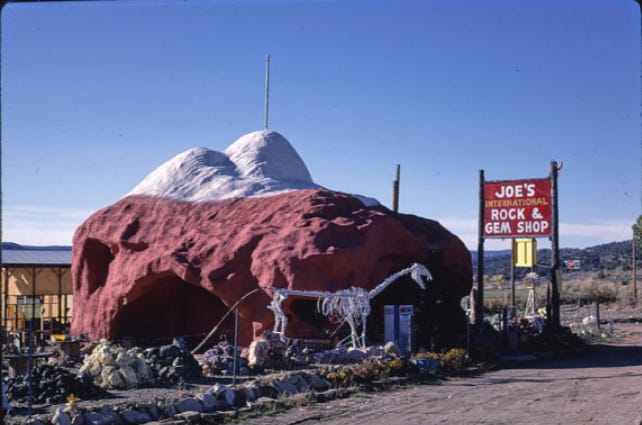
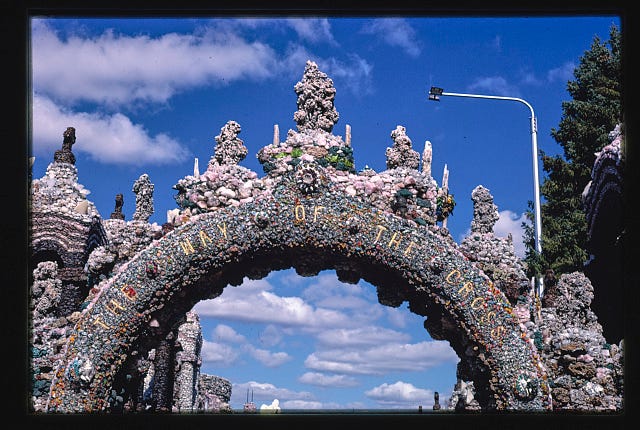
The Library of Congress has just entered some 11,000 photographs of roadside attractions, gas stations, old buildings, and other obscured American novelties into the public domain. It’s a testament to the camerawork of architectural critic and photography John Margolies, whose life’s work was to criss-cross the country over the span of decades to capture these monuments and icons, rendered in an odd, almost funerary style (he would only take a photo if he could “capture the subject in full sun with a cloudless sky, with no people in the frame”, says one write-up). This is, in a way, fitting: Baudrillard never tired of describing America as a land of disappearance—a twist on Deleuze’s own appraisal as the nation as one founded on escape—and these things are themselves vanishing into time. What few remain are reminders of the now-long past moment of the automobile, the Fordist assembly line, and the culture of generic nomadism that these called into being.
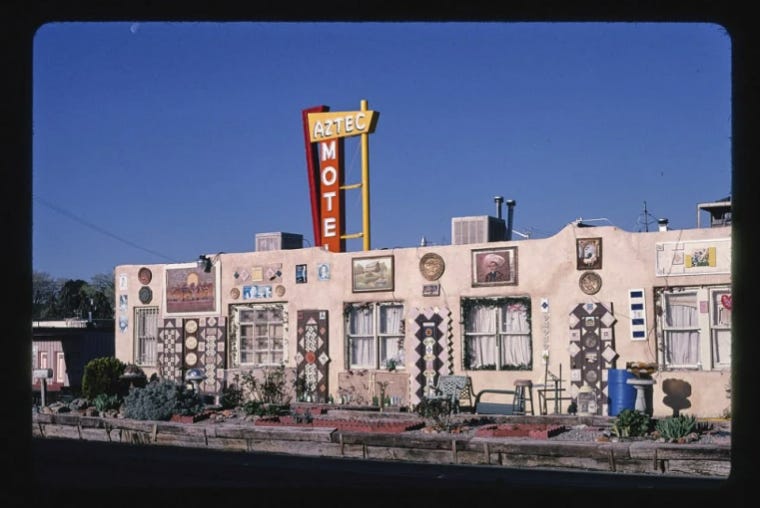
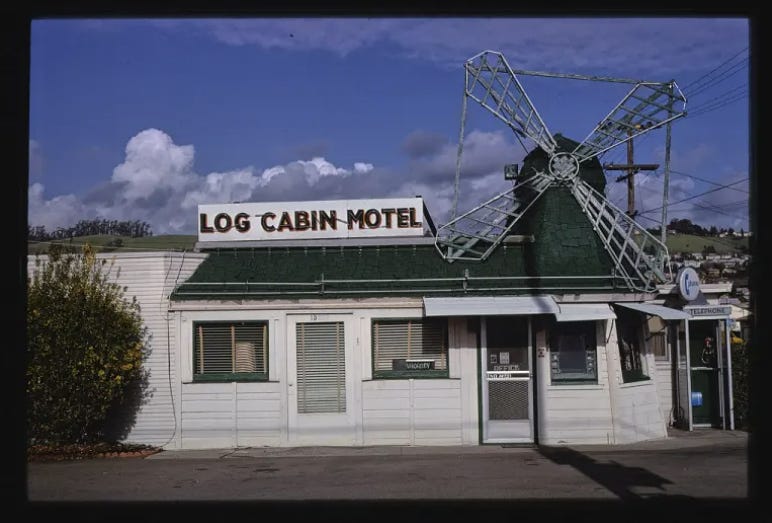
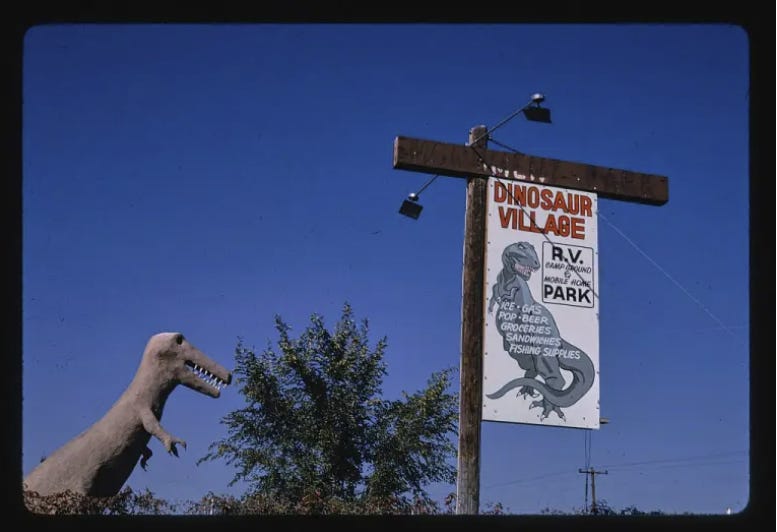

Margolies’ photographs span a spectrum of styles and forms, running from New Deal-era buildings constructed in the WPA Moderne mode to the art deco flourishes of small-town theaters, but what interests is the most is the sort found above: the ramshackle, folksy, and un-finessed kind of expression that eludes easy classification. It comes close to what since the 1970s has been described as art brut or ‘outsider art’, but this labeling has only ever been a retrograde sort of typology that works only from within the cozy confines of the artistic canon—where things have been entombed within the cultural mausoleum. By extending its reach to what is deemed outside it—manifested, in a round-about way, as something pathological that is now deemed acceptable—the vibrancy and life of these kinds of expressions undergoes conversion into the quiet stillness of capture.
These things also converge on the territory of kitsch, and in this sense collide with the discourses around postmodernity. Kitsch, per the analysis offered by Frankfurt School thinkers like Adorno, is the inevitable byproduct of mass-scale industrial society. The term itself is likely to derive from the German verb verkitschen, “to cheapen” or “to make cheap”, and for the intelligentsia, its arrival in cultural history signaled the erasure of the gulf between ‘high’ and ‘low’ forms of art.
Jameson, in Postmodernism, describes postmodernity as exhibiting a particular ‘populist’ aesthetic sensibility. Whereas once the “high modernism” of a Le Corbusier or a Ludwig van der Rohe reigned, there was then a sudden shift towards the
‘degraded’ landscape of schlock and kitsch, of TV series and Reader’s Digest culture, of advertising and motels, of the late show and the grade-B Hollywood film, of so called paraliterature, with its airport paperback categories of the gothic and the romance,the popular biography, the murder mystery, and the science fiction or fantasy novel…
The vanishing line between ‘high’ and ‘low’ is indicative of postmodernity’s prime characteristic, the “loss of historicity” that sees all distinctions marked by time and space smeared across a singular social field. This loss carries with it a regressive side, felt most immediately in the sense of an all-encompassing stagnation; this sensation frequently carries with it an active eschatological element rendered in a profane negativity (apocalypse without the light of salvation). But there is a flip side here: with the vanishing of history the actions and cries of ten thousand generations no longer pound in the heads of those living in the present, and what was once action in the strong sense of the word can be replaced by idiosyncratic forms of cultivation. The site of this ‘new’ work is the surface, now freed from the grasp of the depths (because depth is always a matter of history). Beyond high and low, time and history, the very distinction between surface and depth becomes troubled and undermined. At this point, more than ever, does the statement “Deeper than any other ground is the surface and the skin” ring true.
The play of the surface is pure expressive texture, and in relation to the geography of the American landscape, this is exactly what the kitschy roadside attraction and weird building, sculpted by the hands of a legion of anonymous, sloppy craftsmen, is all about. It’s also what is at stake in surrealism. As Deleuze implicitly suggests in The Logic of Sense, surrealism is the overcoming of sense and nonsense at the level of the surface—and there is something profoundly surreal about these concrete and paper mache teepees, igloos, oversized animals and humans, dinosaurs, cartoonish depictions of pioneers and malformed (bordering on the grotesque) businesses and dwelling places. If the vital impulse of the modernist avant-garde was to overcome the distinction between daily life and the art-form—“Let’s not look at a De Chirico painting; let’s live in one”—then this has been realized in this squishy underside of Fordist mass culture, even if it was the first blast of the postmodern mode.
Franklin and Penelope Rosemont, of both the I.W.W. and the Chicago Surrealists, wrote of a buried tendency flowing beneath American culture that they dubbed ‘vernacular’ or ‘everyday surrealism’. Their description, which captures something approach pop art without its elitist or commercialist pretensions, directly presages Jameson’s “‘degraded’ culture” beyond the high/low distinction:
…true poetry surfaced far more often in odd corners of popular culture: in comics (from George Herriman’s Krazy Kat to Walt Kelly’s Pogo), in films (from the silent comedies to the Marx Brothers and Veronica Lake and beyond), in the animated cartoons of Tex Avery and others, in such wildly independent eccentrics as Simon Rodia (creator of the amazing towers in Watts, California), Mary MacLane of Butte, Montana, and the fantastic IWW writer T-Bone Slim (sometimes called the Lenny Bruce of the labor movement), and of course in that inexhaustible fountain of inspired and inspiring poetry known as the Blues.
Paul Baron, himself a member of the Chicago Surrealists, took up this last point in his 1975 book Blues and the Poetic Spirit. In the words of surrealism’s most vocal proponents, the form (like dada before it) took its cues from Freud’s discovery of the unconscious; their goal was to liberation it from its chain in the depths, and let the imagination ‘claim its rightful place’. Baron found this same dynamic at work in blues more generally: the music worked by way of symbols and dreamscapes, serving as the place where that which is repressed in daily life could move to the surface. There is a line, non-existent but nonetheless real, that connects Tristan Tzara to the blues—”phantoms, magic, sexual liberty, dreams, madness, passion, folklore, and real and imaginary voyages”.
There is also a line between the blues as surrealist art and the content of folk music more generally, which Greil Marcus has described as the expression of the “old, weird, America”. The artifact that allows Marcus to open the door to this continuum, obscured and buried in its own right, was Harry Smith’s Anthology of American Folk Music. Like the roadside attractions, this compilation of rare tracks, cob-webbed by layers of hiss and crackle, erupted right in the heyday of Fordism. Published in 1952, it was flanked by a succession of works diagnosing the strange, new and unpleasant character of the time: Whyte’s Organization Man, Wilson’s The Man in the Gray Flannel Suit, White Collar and The Power Elite by Mills, Packard’s The Hidden Persuaders.
Smith’s work, featuring Robert Fludd’s ‘Celestial Monochord’ as its frontpiece, pointed to something entirely contrary to world that these books were describing. Marcus likens it to Benjamin’s Arcades Project by taking up Susan Buck-Morss’ point that the goal was to “accomplish a double task: it would dispel the mythic power of present being… by showing history and modernity in the child’s light as archaic”. The American Folk Anthology did just this by resurrecting the ghost of the ‘archaic’ and the ‘primitive’ in order to explode the plastic, air-conditioned and well-regimented world dominated by pseudo-collectivist corporations and the military-industrial complex. Smith, with deep roots in hermeticism, no doubt saw the records as something of an alchemical working, though the raw materials of this arcane experiment were the lingering traces of “minstrel troupes and medicine shows”, tent revivals, rail-riding drunkards, miners down at road’s end, the outlaw, the revolver. Each track is an outpouring of the symbolism and superstition that colored (and continues to color) America-life. The song “Fatal Flower Garden” describes a boy lured to his doom by a woman bearing in her hands apple seeds, golden rings and diamonds; “I wish I was a Mole in the Ground” expresses a desire to transform into a variety of creatures and the fear of the “railroad man”, who will “drink up your blood like wine” (Bob Dylan would later take up this line, and advance the imagery into even odder territories in “Stuck Inside of Mobile With the Memphis Blues Again”, found on his 1966 album Blonde on Blonde).
If what is retroactively taken as folk music describes everyday life, it is an everyday life that exists without distinction between itself and dream—an evening realm of phantasy.
If this continuum that transcends time and space, heterogeneous fragments woven together into a common cloth, is indicative of a ‘vernacular surrealism’, then the varied signifiers, symbols, and inexplicable meanderings (occurring at various points as music, painting, the written word and built environment) are the scattered hints and clues of the great unconscious mind at work. Whose unconsciousness? That of the “silent majorities”—not the silent majority of Nixon—or today, Trump—but the one that evades statistical classification and political legibility. But if these ‘majorities’ are silent, it is only silence in the sense that they cannot be directly seen—yet clearly they have a voice.
Post III: The Humor of Surfaces (07/17/2020)
A few stray thoughts continuing off from the last post on roadside attractions and kitsch Americana as ‘vernacular surrealism’—
If America, with its complicated approach to the depths of history and focus on self-cultivation (in the face of ‘symbolic deficiency’) can be most immediately understood through the notion of the surface, then the relationship that this country has towards sense and nonsense is likewise one that becomes quickly scrambled. Indeed, there is something of an obscene alliance between the strange byways that characterize the American experience—the alien character of its landscape and iconography—and what is regarded as common sense (or the ‘pragmatic’ mindset).
As I wrote in the previous post, Deleuze’s Logic of Sense—a work described by Fisher as “one of the strangest landmarks in Psychedelic Reason”—uses the primacy of the surface to destabilize the orderly binarization that cleaves apart standard notions of sense and nonsense. “Nonsense and sense have done away with their relation of dynamic opposition in order to enter into the co-presence of a static genesis—as the nonsense of the surface and the sense that hovers above it. The tragic and the ironic gave way to a new value, that of humor”. “Humor is the art of surfaces and of the doubles”. “…humor is the co-extensiveness of sense with nonsense”.
For Deleuze, irony is always a matter of ascent: while it is a kind of proposition that forever masks its truest intentions, it is still a form of judgement in that it ranks things in accordance with a particular hierarchy. Its ultimately aim is to resolve elements into the One. Humor, on the other hand, poses a dialectical relationship of a very different sort (and here it has something of an uncanny resemblance to the Maoist dialectic, which gets an all too hasty dismissal at the start of A Thousand Plateaus): it holds the divergent series apart, in this case sense and nonsense, while at the same time keeping them in close proximity. Contrary to the ironic ascent, humor descends, but what it descends towards isn’t the abyss or the depths, but the surface itself.
Thinking America in conjunction with humor understood in this manner explains why Baudrillard is the best of among the post-’68 continentals at capturing the peculiar thisness of the country’s aleatory landscape (and I say this as someone very fond of Deleuze’s own mythic portrait of America, which nonetheless properly points to the importance of divergence). Critics of Baudrillard in his own time rightly pointed towards the sheer nonsense of what he was saying and writing, while his contemporary take-up by those of a more right-wing or post-right inclination tend to code him as a dour, even miserablist, critic of the hyperreal condition. Both of these approaches miss out on the humor that explodes through in each twist and turn of his work, the playful succession of ambivalences that he continually put in motion. He was a crank no doubt, but he also clearly understood himself in that role. So for every hard-hitting analysis, like the critique of Foucauldian ‘microphysics of desire’ as the very logic of capital’s control system and not its contrary, there are episodes like his performance in Vegas: hanging out in the pulsing heart of the simulacrum, Las Vegas, in a golden Elvis suit and reciting poetry.
Deleuze’s understanding of humor is that of a paradoxical formation, maybe even paradox in itself, and Baudrillard puts this on full display in America:
We [Europeans] live in negativity and contradiction; they [Americans] live in paradox (for a realized Utopia is a paradoxical idea). And the quality of the American way of life resides for many in that pragmatic, paradoxical humour of theirs, whilst ours is (was?) characterized by the subtlety of our critical wit. Many American intellectuals envy us this and would like to fashion a set of ideal values and a history for themselves, and relive the philosophical or Marxist delights of old Europe. Yet this runs against the grain of everything that makes up their original situation, since the charm and power of American (un)culture derive precisely from the sudden and unprecedented materialization of models.
***
The tragic holds an ambiguous place of its own in Deleuze’s work. On the one hand, the ‘true’ sense of the tragic is bound up in the overcoming of the negative and constitutes itself as a force of affirmation (and in this sense it is quite uninteresting), while on the other it is the “closed space” of phantastical representations that are reinforced by the social field. In the Logic of Sense, the myth of Oedipus is, as one would expect, held up as the tragic story par excellence. While Deleuze does not, at this stage, consider the implications of the temporal structure of the myth, it is exactly this structure that makes Oedipus so paradigmatic for understanding the dynamics of capitalist structuralization: the loops of time consecrate an ever-repeating, inescapable destiny.
By the time of Anti-Oedipus, time-scrambling does enter the picture as a way to explain the reproduction of the capitalist symbolic order:
Capitalism institutes or restores all sorts of residual and artificial, imaginary, or symbolic territories, thereby attempting, as best it can, to recode, to rechannel persons who have been defined in terms of abstract quantities. Everything returns or recurs: States, nations, families. That is what makes the ideology of capitalism “a motley painting of everything that has ever been believed”. The real is not impossible; it is simply more and more artificial.
The abstract quantities designates the synthetic body of the proletariat, a child of modernity as much as the machinery that capital continually develops; it’s important then that Marx wrote in The German Ideology that the rise of abstract labor—the production of wealth detached from any one individual—”is most pronounced in the United States, the most modern form of bourgeois society”. The compensatory dynamo, which dredges up a spectacular form of the past as the orientating guideposts for social order, is the conversion of this synthetic, mutable thing into a naturalized organicism.
This is also the same dynamic identified by Deleuze and Guattari as taking shape within American literature: the ‘break’ that seeks to overcome the “capitalist barrier”, which consistently fails to do so, and thus find itself trapped back in box of depth and ‘established'(artificial) identity (most commonly in the recoding with Europe).
Yesterday Kantbot unleashed a lengthy thread on the tl addressing the ‘instrumentralization’ of the unruly and transgressive (and mostly online) subcultures that blossomed in the in the years leading up the 2016 election of Donald Trump. His retrospection is quite fascinating, and conforms closely to this schema. He began by tracking out these network’s roots at the dawn of the new millennium:
[Post now lost to time]
No doubt the importance of atheism at this stage is a sign of troubles ahead: this dismal, positivistic kind of atheism was a sign of Last Man syndrome at its worst. In their fastidious commitment to challenging all that is ‘irrational’, they missed out the double-role that makes religion so important—1) the ritual, which as Pascal pointed out was necessary in establishing belief; and 2) that Christianity in particular itself posited the (continually restaged) formation of an anorganic community profoundly out of joint with its own time. Suspended between the two—belief and the formation of community—the ability to carry out the necessary task of bringing the negative against the full weight of the world is lost; the ‘nu atheist’ becomes just another figure in a series of passive critics of everything under the sun, committed to the persistence of the postmodern circling about on its worst side. Hence the schizophrenia: the pseudo-subversive atheism that Kbot alludes to, that attacked the unity of American empire and fundamentalist religion, but fervent atheists who took up the neocon call precisely because of its stated promise of modernizing the ‘non’-modern world.
Nu-atheism, at best, was an artificial negativity, and the recoding of some of its factions into the momentously traditional conservatism that became hegemonic in the post-2016 era was in hindsight a completely expected reversal.
Fast forward into the heat of 2015: proliferating online subcultures and memetic overload play right into a mounting hysteria about the ‘post-truth’ moment and the rise of populist ‘demagoguery’. The subversive edge can be felt here, in that for a single moment it seemed as if the mass media cartel and the script-writers for the reality studio were being undermined. Long ago, Vince Garton wrote a great blogpost probing the spectral outlines of a ‘digital subjectivity’ that could then be glimpsed on the horizon—an unintelligible mass that was perceived as the voiding-out of the rational, Kantian subject that liberal politics assumes (or at least claims to assume—Lippman-style public management is a whole other story).
Irony was treated as the defining motif of this moment—with irony being understood as a permanent distancing effect and a strategic ambivalence crafted in a willfully nihilistic mode. But maybe we should understand this irony in a double sense, with the aforementioned as the ironic foreground and irony in the Deleuzian sense—as an obscured form of judgment—as its deeper structure. What sort of judgment was this? An all too regular judgment, one psychically tethered to the re-establishment of ‘artificial, symbolic territories’ (MAGA, now fully unmasked as a codeword for the maintenance of the Eternal Now). Irony and tragedy here intermingle, and neither is overcome (which is never their full abolition; only their reconstitution in a re-new-ed form).
The humors of the surface, circling around the real Thing, deferred.
Post IV: Nostalgia for the End (07/24/2020)
Hypertelia: “a process of something surpassing its function or objective”.
“With systems of economy, knowledge, and production, if they go too far in one direction they get carried away and over-reach their own limits, and at this moment lose themselves in reversal” — Baudrillard, Selected Interviews
Kojève’s provocative suggestion was that the US, at its mad-Fordist height, was the end of history, and was effectively the achievement of the communist state of being anticipated by Marx and Engels. The Soviets were simply ‘poor Americans’, working feverishly to play catch-up. However insane this suggestion might appear, let’s assume, for the sake of blogging, the truth in it. The question instantly becomes: if that moment was post-history, what does it mean to be on the other side of it—to be living after the end of history has come to an end?
Contemporary society is characterized by a jagged paradox. On the one hand, there is the abscence of history, as an order organizing time (this doesn’t mean, of course, that events do not happen); while on the other, the symbolic deficiency that arises from this absence doesn’t eliminate meaning. The whole of ‘late’ capitalist civilization presents itself as a vast machine designed for the mass production of meaning, which rises up in the extreme vertigo of excessive presence. The intimate link between the generation of meaning and historical movement—history and meaning as the double-result of action— has become broken, leading to an intractable crisis of intelligibility and orientation. One side signals the reality of history, the other its disappearance. As a result the prevailing social order moves under the mushroom cloud of anomie.
Vince sees in China a different sort of posthistorical moment taking shape: under Xi, contradictory forms of governance, temporalities (witness the marriage of the traditional and the hyper-modern) and even modes of production are placed alongside each other, held together by direction of the Party now serving as a managerial regime. In a reversal of Thiel’s claim that Xi has brought posthistory to its close, the Chinese government carries out its work beyond history. This doesn’t mean that development is over: it is produced through the tensions cycling through this unification (not synthesis) of the One and the Many.
China thus seems to have figured out an alternative to the crisis of negation, the breakdown of the negation of negation, by simply advancing forward with Mao’s own jettisoning of dialectical resolution. In its place is the management of paradox—and compare this with the West, where the paradoxical runs amok with the full permissiveness of an acephalic leadership. Neither of the poisonous double gift of American capital that we see today—the ‘socially-conscious’ corporation and the terror of homeland security—indicate anything other than the promise of a tremendous void.
Everywhere is the aftermath of the 2016 election cycle: social democracy is dead in the water, and the ‘anti-establishment’ right plummets into reheated neoconservatism, incapable of abatting domestic catastrophe while ratcheting up international tensions (the real humor of the apparent war-path with China is that, behind it, the much longed-for act of ‘decoupling’ appears to have been quietly discarded as a policy agenda). There’s little reason to relitigate that election, or re-iterate what has already been said (and everything that can be said about it has been said about it), but the now-classic framing is that it was a conflict between a technocratic, centrist establishment and a populist insurgency of the left and the right. As the center appears as the inheritors of end-of-history in the Fukuyamian mode, the sudden re-appearance of the masses as a potent political force made it seem like history was returning, inch by inch, to resolve contradictions that had been left dangling.
Yet look at the content of the left and right populisms. It wasn’t merely the status of outsider politics that they shared in common: it was a desire to turn time back to a previous stage of capital—each, in actually, desired exactly the same moment in time: the American posthistorical moment. Contemporary populism—and here is where it may differ from historical populism, at least in the American experience—is a politics logged in what Jameson called nostalgia mode. Nostalgia mode, an indicator of an eternal present haunted by past forms which it then ‘cannibalizes’, is for Jameson the defining cultural trait of postmodernism; it’s interesting, then, that postmodernism begins at the very moment that posthistory ends. While this might very well be an indicator of terminological insufficiency, it also hints at the strange topographical character of these entangling lines. Non-simultaneity, nonsynchronism: nothing is evenly distributed.
In his 1943 book The Road We Are Travelling, Stuart Chase—known best perhaps for being the coiner of the term ‘New Deal’—described the transformation, occurring in multiple countries across the world at precisely the same moment, of the free enterprise system into something he could only describe as X. The characteristics of X were
A strong, centralized government.
An executive arm growing at the expense of the legislative and judicial arms. In some countries, power is consolidated by a dictator issuing decrees.
The control of banking, credit and security exchanges by the government.
The underwriting of employment by the government, either through armaments or public works.
The underwriting of social security by the government…
The underwriting of food, housing, and medical care by the government…
The use of deficit spending techniques to finance these underwritings…
The abandonment of gold in favor of managed currencies…
Etc, etc.
Chase suggested that nobody—not the capitalists, nor the ‘orthodox socialists’—desired or necessarily supported whatever X was. But if X, in retrospect, marked the moment of posthistory, then it is the object of an all-pervasive political and cultural desire, even if it is not actively realized as such.
KB’s post is on archive